
Our Aims and Objectives
We are the UK association for all those who research, study and teach global development issues
Find Out MoreAdvancing development studies as a field of scholarship
We are committed to advancing development studies by supporting our members’ research. Our current publications include a highly-regarded book series with Oxford University Press, the DSA blog, and our publishing support during conference.
We are open to new publishing members interested in collaborating to promote publishing at our annual conference.
Critical Frontiers of Theory, Research, and Policy in International Development Studies
The contemporary world is characterised by massive wealth alongside widespread poverty, inequality, and environmental destruction – all bound up through class, race and gender dynamics of inequality and oppression.
Critical Frontiers of Theory, Research, and Policy in International Development Studies is the official DSA book series published in collaboration with Oxford University Press and was established to contribute to critical thinking about local, national and global processes of structural transformation. The series publishes cutting-edge monographs that promote critical development studies as an interdisciplinary and applied field, and shape the theory, practice, and teaching of international development for a new generation of scholars, students, and practitioners.
Series editors
The current editors are Jayati Ghosh (University of Massachusetts Amherst), Naomi Hossain (SOAS), Briony Jones (University of Warwick), Alfredo Saad Filho (King’s College London) and Benjamin Selwyn (University of Sussex). James Cook is Commissioning Editor for the series at the OUP. “We are always excited to see new proposals and hear about new ideas, so if you are involved in research that you think might be of interest do let us know. The series editors are really helpful with advice in developing book proposals and commenting and I’m keen to see the series continue to develop and grow over the coming months and years.”
Publish with us
As the series evolves, we wish to publish a diverse and inclusive range of authors whose work engages in critical, multidisciplinary, decolonial, and methodologically plural development studies. If you have an idea for a book proposal, contact the OUP Commissioning Editor, James Cook: [email protected]
Read the perspectives from authors from the book series:
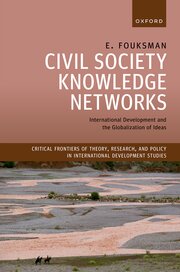
By E. Fouksman
Investigates the creation, spread, and contestation of ideas within global development networks. It traces the power of ideas, epistemic inner-workings, and linkages between global, meso, and local scales via development-focused civil society and communities. More…
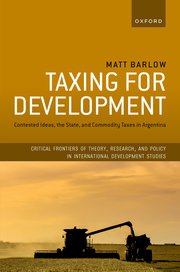
By Matt Barlow
Using the case of Argentina, the book examines, empirically, the attempts by progressive-Peronist governments of Néstor and Cristina Kirchner to finance state expenditure and social welfare via taxes on commodity (mainly soybean) exports after 2001. More…
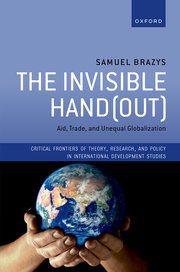
By Samuel Brazys
Examines the relationship between foreign aid, market access, and economic growth in developing countries during the era of globalization. Despite the rapid integration of global markets lifting millions of people out of poverty, disparities remain, with some nations thriving while others falter.. More…
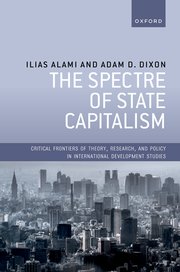
By Dr Ilias Alami and Prof Adam D. Dixon
We are currently witnessing a historic arc in the trajectories of state intervention, characterized by a drastic reconfiguration of the state’s role as promoter, supervisor, shareholder-investor, and direct owner of capital across the world economy. More…
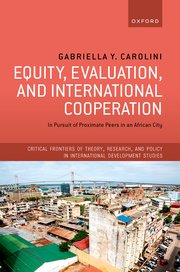
By Gabriella Y. Carolini
Examines whether South-South Cooperation (SSC) truly differs from traditional international partnerships. By shifting focus from macro-geopolitics to ground-level projects in Maputo, Mozambique, it explores equity and evaluation within the water-and-sanitation sector. More…
By Graham Harrison
Uses a historical comparative approach to understand development as a transformation which involves a deep and integrated political economy of change – a shift from a state of ‘capital-ascendance’ to ‘capital dominance’. More…
By Jewellord T. Nem Singh
As the world moves towards decarbonization and the race for clean energy technologies accelerates, states in the global south are increasingly called upon to supply critical minerals to fuel the transition. Business of the State details how mineral states might design effective growth strategies in this context. More…
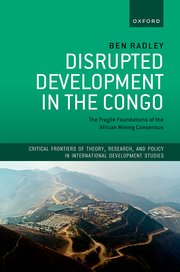
By Ben Radley.
Through an in-depth case study of mining in the Democratic Republic of the Congo, the book details how foreign corporations have been prone to mismanagement, inefficiencies, and rent-seeking, and implicated in fuelling conflict and violence. Three open access chapters. More…
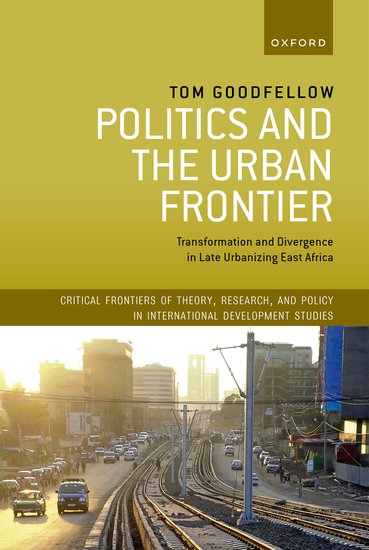
By Tom Goodfellow
Despite the rise of global technocratic ideals of city-making, cities around the world are not merging into indistinguishable duplicates of one another. In fact, as the world urbanizes, urban formations remain diverse in their socioeconomic and spatial characteristics, with varying potential to foster economic development and social justice. Open Access. More…
By John Toye
This book explores the sociological and economic history of human progress since Adam Smith. It traces development from Enlightenment grand narratives to narrow 20th-century strategies and modern fragmented research, arguing that neglecting social context limits policy success. More…
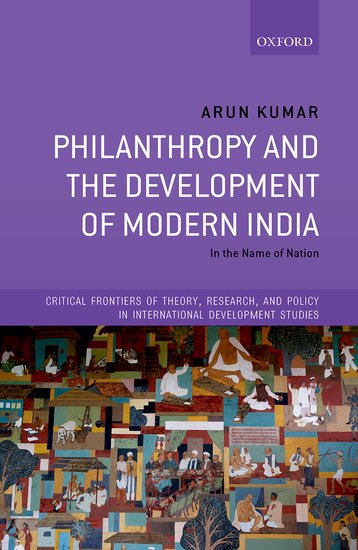
By Arun Kumar
Drawing on the history of the philanthropy of India’s economic elites, the book discusses how their ideas and understanding of development have shifted and changed over time. It interrogates the changes in development imaginaries in terms of modernity’s entanglements with the national question, including anti-colonial nationalism and post-colonial nation-building. More…
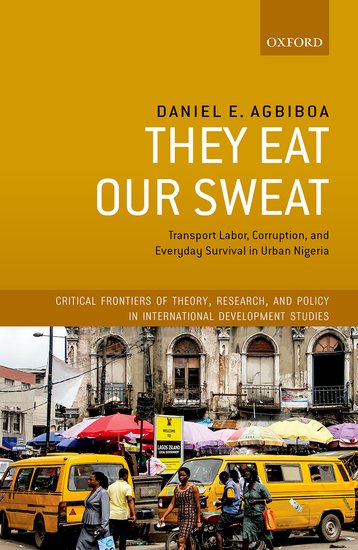
By Daniel Agbiboa
Investigates the workaday world of road transport operators as refracted through the extortion racket and violence of transport unions acting in complicity with the state. It looks at the corruption complex in Africa through a micro analysis of its informal transport sector, where collusion between state and nonstate actors is most rife. More….
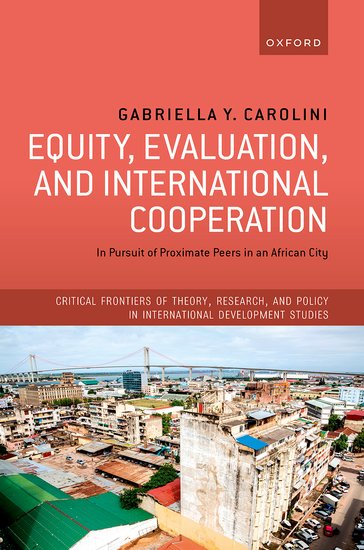
By Gabriella Y. Carolini
This book examines if South-South Cooperation truly differs from traditional partnerships. Shifting from macro-geopolitics to a ground-up study of water and sanitation in Maputo, Mozambique, it explores the ecosystem of international projects to offer fresh practical lessons. More...
By Philip Martin.
The Prosperity Paradox explains why farm worker problems often worsen as the agricultural sector shrinks, and lays out options to help vulnerable workers. Analysis of farm labor markets in the US, Mexico, and other countries shows that unions and fair trade efforts to protect farm workers cover a very small share of all workers. More...
By Tanya Jakimow.
Offers a comparative ethnography of two types of local development agents: volunteers in a community development program in Medan, Indonesia, and women municipal councillors in Dehradun, India. More…
By Sabina Lawreniuk and Laurie Parsons
Rising levels of global inequality and migrant flows are both critical global challenges. Set within the Southeast Asian nation of Cambodia, Going Nowhere Fast sets out to answer a question of global importance: how does inequality persist in our increasingly mobile world? More…
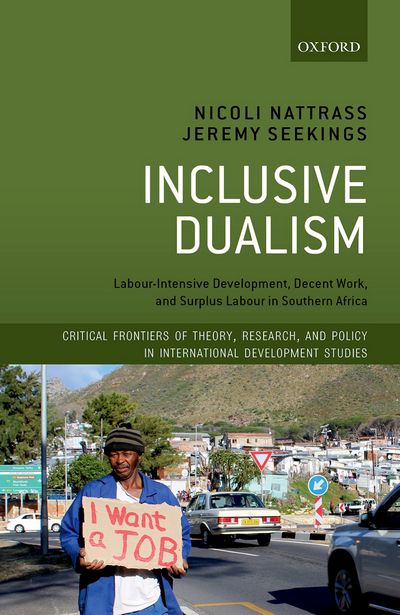
By Nicoli Nattrass and Jeremy Seekings
Argues that decent work fundamentalism, that is the promotion of higher wages and labour productivity at the cost of lower-wage job destruction, is a utopian vision with potentially dystopic consequences for countries with high open unemployment, many of which are in Southern Africa. More…

By Yilmaz Akyüz
Playing with Fire provides an empirical account of deeper integration of emerging and developing economies into the global financial system and discusses its implications for stability and growth, focusing on the role of policies in the new millennium in both EDEs and the United States and Europe. More…
By Matteo Rizzo
Reveals the political economy of public transport, exposing the limitations of market fundamentalist and post-colonial scholarship on economic informality, the urban experience in developing countries, and the failure to locate the agency of the urban poor within their economic and political structures. More…
By Naomi Hossain
From an unpromising start as ‘the basket-case’ to present day plaudits for its human development achievements, Bangladesh offers proof that the neo-liberal development model works under the most testing conditions. How were such rapid gains possible in a context of chronically weak governance? More…
We are pleased to have the long-standing support of Practical Action Publishing, the specialist publishing arm of global change-making organisation Practical Action. You can find out how to publish with them and how libraries can access their titles.
Read more about them in this spotlight for their 50th anniversary of publishing knowledge for change.
To find out more about their titles visit their website, follow them on BlueSky, Facebook or LinkedIn. We also include their latest publications in our newsletter – sign up here.
Join us!
If you’re a publisher and would like to become a member email us. You can also find out about how to book a stand or advertising space at our annual conference and reach hundreds of development studies academics and practitioners.
Special Issues
Briefing Papers