
Rights, wellbeing, action: towards securities of frontline social workers in India
Blog by Aishwarya Bhuta, University of Sheffield
This research collaboration between Aishwarya Bhuta and The Solidarity Network (an initiative by Shakti Shalini, a grassroots NGO in India) highlights the insecurities that frontline social workers face, and their recommendations for improving their securities and wellbeing.

Research partnerships beyond academia have immense potential for impact. The research study titled ‘Most Burdened, Least Supported: Towards Security and Wellness of Frontline Social Workers’ was one such example of co-production of research between frontline social workers from Shakti Shalini, a non-governmental organisation (NGO) founded in 1987 in New Delhi, India, and myself, an academic researcher.
Shakti Shalini is committed to advancing gender equality and has been providing response services to survivors of sexual and gender-based violence since inception. Shakti Shalini initiated The Solidarity Network in 2019. This is a pan-India network of frontline social workers and human rights defenders affiliated with NGOs, civil society organisations, and other collectives; independent social workers, and other professionals. It offers them a safe space to discuss challenges and co-create solutions to enhance the safety, security and wellbeing of frontline social workers.
What the research aimed to achieve
Frontline social workers form the backbone of all humanitarian and social justice efforts across the globe. Our study assesses the current physical, psycho-emotional, and financial security and wellbeing among frontline social workers in India. We also compile recommendations on improving security and wellbeing among frontline social workers. In doing so, our larger objective is to create a preliminary blueprint for future action and hope.
How we did this
We employed a mixed methods design. The first phase involved a key stakeholder consultation with 32 members of The Solidarity Network. For the second phase, we developed a draft questionnaire and piloted it with two respondents. The revised online anonymous questionnaire was disseminated among The Solidarity Network, independent frontline social workers as well as those affiliated with any NGO or similar entity, representatives of development sector organisations employing frontline workers, and through social media channels. A total of 63 frontline social workers participated in the survey.
What the research showed us
- Experiences of physical security among frontline social workers are gendered. Less than two-thirds of the women respondents agreed to feeling physically secure compared to 95% of their male counterparts.
- Only 30.2% of the frontline social workers surveyed have access to personal protective equipment at their workplace.
- Less than half of them (44.4%) have access to confidential mental health support and wellbeing check-ins at their workplace.
- Only a quarter of the frontline social workers surveyed (25.4%) have job security including formal working arrangements.
- Only 36.5% of the frontline social workers surveyed are being provided employee benefits.
Recommendations for funding agencies
Physical security
- Earmark dedicated funds within every project or grant to support the physical safety and mental health needs of frontline social workers
- Incorporate explicit safety and security measures for frontline social workers into the reporting and compliance requirements of grantee organisations
Psycho-emotional security
- Strengthen downward accountability by encouraging organisational leadership to provide verifiable evidence of ethical employment practices toward frontline staff
- Provide dedicated funding for worker-led collective care initiatives
Financial security
- Provide flexible, multi-year funding instead of short-term, output-driven grants that exacerbate precarious employment
- Ensure a notice period of at least three months before grant discontinuation.
Recommendations for leadership and management of organisations
Physical security
- Integrate safety into organisational planning
- Strengthen workplace infrastructure and security
- Enhance field safety measures
- Ensure crisis support and building capacity for risk management
- Strengthen external institutional and community linkages
Psycho-emotional security
- Strengthen leadership-field engagement
- Foster a respectful and inclusive organisational culture
- Recognise and value frontline labour
- Prevent burnout and emotional exhaustion
- Institutionalise peer support and collective care
Financial security
- Integrate security as a priority in planning and budgeting
- Formalise employment arrangements
- Ensure fair and lawful remuneration
- Provide allowances and work-related support
- Strengthen social protection and long-term security
- Invest in career growth and financial literacy.
Recommendations for law enforcement agencies and state actors
Physical security
- Appoint designated liaison officers for timely support
- Ensure fast-track proceedings for cases involving violence or threats against frontline social workers
- Strengthen the enforcement of laws related to workplace safety, harassment, and violence against frontline social workers
Psycho-emotional security
- Periodic sensitisation and capacity-building
- Ensure survivor-centric and worker-centric policing practices
- Strengthen institutional convergence
Financial security
- Establish dedicated legal and emergency support funds
- Prevent economic retaliation and harassment
- Provide compensation and financial protection mechanisms
- Strengthen access to social protection schemes.
Building on the findings, we are working to disseminate the findings and recommendations to these key stakeholders. We began our dissemination efforts by organising an event to initiate this important conversation with frontline social workers and other stakeholders. Shakti Shalini will continue to collaborate with The Solidarity Network to translate findings of this research into actionable strategies for improving security and wellbeing on the ground.
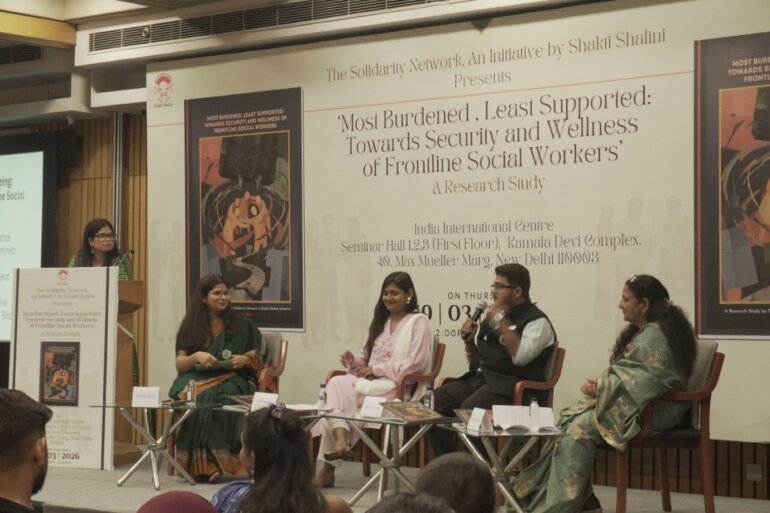
Panel discussion with frontline social workers, New Delhi, 19th March 2026
Our study was the first of its kind attempt to broaden the definition of frontline work to include frontline social workers in the social and development sectors in India. In addition, this was a pioneering study integrating three interconnected dimensions of security and wellbeing (physical, psycho-emotional, and financial) rather than focusing on the psychological dimension alone.
Potential directions for future research include compiling emerging and notable practices evidencing what works for advancing the securities and wellbeing of frontline social workers in varied contexts, particularly with reference to those from intersectionally disadvantaged backgrounds.
Aishwarya Bhuta is a postgraduate researcher at the School of Geography and Planning, University of Sheffield.
Contact: [email protected]