
Reimagining the World to Change it: Reflections on Participating in the DSA2026
Aishwarya Bhuta, a PhD candidate at the University of Sheffield, reflects on her experience of participating in the DSA2026: ‘Reimagining Development: Power, Agency, and Futures in an Uncertain World’, July 8-10, 2026 at the University College Dublin.
It was a time of many firsts. I was travelling to Ireland where I had never been before. I was about to present my doctoral work at the Development Studies Association’s annual conference. As a woman postgraduate researcher of colour studying in the UK, this opportunity was huge and long awaited.
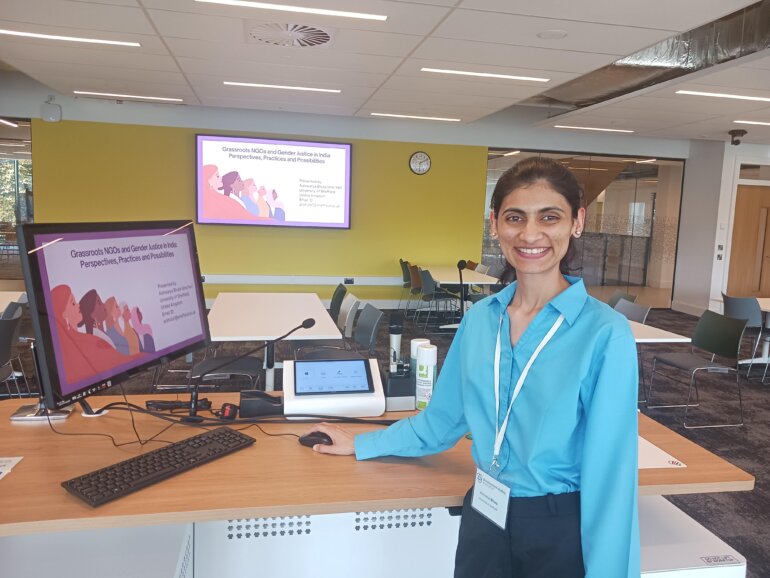
Never before has a day full of panels, sessions and a keynote not felt long to me. It was intellectually stimulating and I wanted more. It was fascinating to learn about the research that participants of the conference have conducted in various geographies. Panels brought together professors, students, established academicians, early career researchers, scholars, and practitioners as presenters. Every conference I had participated in earlier only had students as co-presenters. To share a space with senior academicians in Panel 14 – ‘Grassroots agency and power: Reimagine solidarity and decolonisation’ organised by the NGOs in Development Study Group was encouraging and boosted my confidence. My key takeaway from the conference is what Prof. Naila Kabeer said to a couple of us over tea – reimagining helps us break free from the shackles of everything that holds us back.
What stood out for me is how the hybrid setup was not merely tokenistic but truly integrated in the design of the sessions. Panels had a mix of in-person and online presenters. The session on ‘Publication strategies for students and early career researchers – journals’ had a hybrid panel; an equal number of panellists joined online. Given how shrinking research funding poses barriers for participating in conferences organised in the global North, hybrid setups enable greater participation, especially from the global South.
Prof. Naila Kabeer’s thought-provoking keynote lecture urged us to reimagine economies, moving beyond a focus on growth to that on wellbeing and care. She argued that pathways to gender justice require doing away with gendered division of labour, universalising care and care work. As I sat in the audience and looked around the room, it was refreshing to be in a diverse space with many participants from the global South; the conference seemed to be truly global and diverse. It brought together people of different identities, geographies, and institutions. While we were all different in many ways, our shared interest in Development Studies united us as members of a dynamic and flourishing academic and research community.
Few would disagree that a PhD is an isolating experience. That there exists a large community out there which is passionate about all things development was a revelation which filled me with motivation in the present and hope for the future. I came back from the DSA2026 with memorable experiences of presenting my doctoral work to different audiences and meeting academicians I had only read and heard about. But most important of all was my discovery of a large community of like-minded and hopeful development enthusiasts who are, through their meaningful research, reimagining the world to change it – one study at a time.