
Why the next DSA and EADI conferences should be hosted in the global South
By Luqman Ọpẹ́yẹmí Muraina, Department of Politics and International Relations, University of York and Aysha Valery, Institute of Development Studies.
The Development Studies Association conference held annually and the European Association of Development Research and Training Institutes (EADI) held every three years bring together researchers, practitioners, and policymakers to discuss some of the world’s most pressing challenges – such as inequality, sustainability, environment and migration.
Development Studies is a Northern-led multidisciplinary discipline and it remains strongly institutionalised through academic institutions, professional associations, and development agencies in the Global Minority, especially, Europe, Canada, and Australia. The organisation of the DSA and EADI conferences in Dublin and Antwerp respectively this year underscores Development Studies’ Global North institutionalisation and other multiple enduring North-South material and epistemic inequalities.
EADI was founded in 1975 and has mainly hosted its conferences across Europe. By contrast, the DSA was founded in 1978 and DSA2026 was the first DSA conference outside the UK in 36 years, since its establishment 48 years ago.
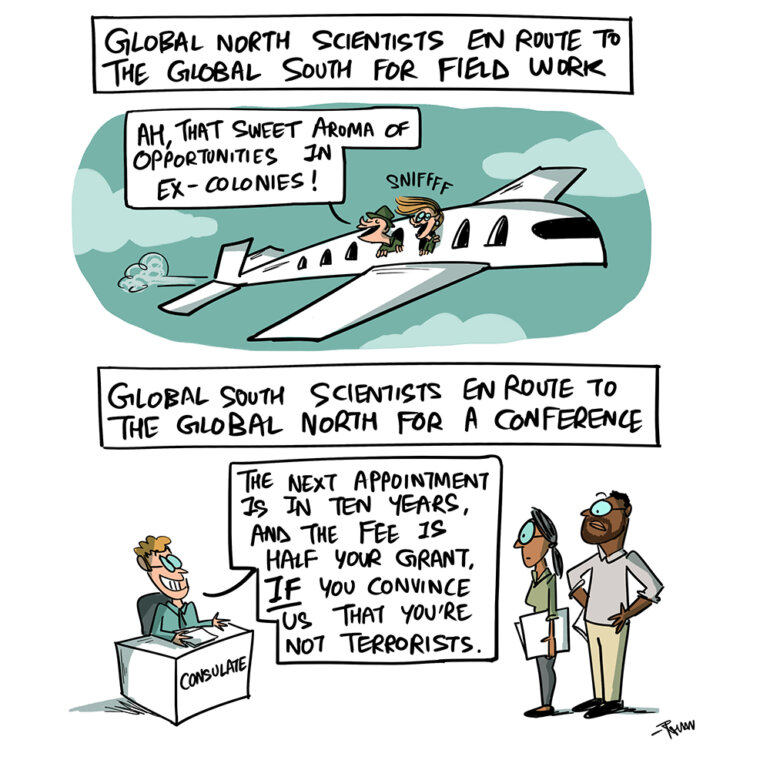
Our provocation emerged during the DSA 2026’s Students’ meeting, whereby we discussed several barriers to attending the DSA Conference for Global South scholars, including visa restrictions and limited resources. This led us to ask why the burden of participation is borne mainly by the Global South members to attend DSA and EADI conferences and to reimagine: what if DSA and EADI co-host some of their conference in the Global South?
We ask this question despite understanding that DSA signalled during DSA2026’s AGM that future conferences would be hosted in the UK, where the DSA is a registered charity, partly in response to the visa restrictions experienced by Global Majority scholars travelling to Ireland. DSA has also published a blog explaining the intricacies and correcting some misconceptions about organising conferences.
Global South Participation: burden and benefit
In the DSA2026 Student’s meeting, we advanced the term: ‘burden of participation’ to frame the access restrictions experienced by Global Majority members due to visa regimes and passport inequality, extending beyond DSA and EADI control. Many educational events in Euro-America have made visa restrictions a significant barrier to participation for the Global Majority. For example, in 2019, only one out of 25 African nationals invited to attend a LSE, UK Workshop had their visas approved and attended.
This burden creates passport positionality: ‘how academics at any level, primarily those with a “Global South” passport, must navigate various ideological, legal, administrative, financial, and psychological barriers to attend academic events or conduct research in countries other than their own’.
Increasing participation for Global South scholars brings additional benefits such as maximising intellectual exchange and cost effectiveness. When many Global South scholars are absent from ‘international conferences’ due to the locations where they are organised, we lose access to additional and diverse cutting-edge research grounded in the Global Majority’s lived experience. Hosting DSA and EADI international conferences in the Global Majority may further facilitate North-South partnerships and redistribute opportunity and burden to participate.
Hosting conferences in the Global South may offer opportunities to reduce organisational costs and potentially more affordable accommodation and diverse food options. Global South locations may also broaden participation by lowering barriers for some attendees and further connecting other attendees to their/new study locations, although further evidence is needed to assess the extent of these benefits and their implications for conference revenues and attendance patterns.
Decolonising and bringing Development Studies closer to development realities
Recent discourse in DS includes that it embraces a “Global Development” orientation, recognising that contemporary development challenges transcend geographical boundaries and affect all societies. However, DS significantly still reflects Global North – South inequality, whereby research agenda, funding, theories, Principal Investigators, conferences and journals are concentrated in the North, while data (collection), collaborators, and programmes remain largely located in the South.
Decolonisation continues as a hot topic in DSA and EADI. DSA2026 showcased 13 panels within ‘Decolonising knowledge, power & practice’ theme and EADI had several panels framed around decolonisation, presentations and also hosted a task group on Decolonising Knowledge for Development. However, in an era where decolonisation is becoming a buzzword and decolonial fatigue is rising, it is important that decolonisation is not taken as a metaphor and to ask: What de-colonial has occurred within institutions disseminating development to the Global Majority?
DSA and EADI must continually address DS’s colonial and civilising mission history and go beyond panels and task groups to reconsider the geography of knowledge production. We believe that hosting DSA and EADI conferences in Kigali, Rwanda or Phnom Penh, Cambodia, would place scholars in development’s discourse environments – poverty and inequality – rather than distant objects of study. Hosting the conferences in the Global South offers opportunities to engage with development not only as an academic abstraction but also as an everyday experience embedded in institutions, communities, and public life.
Beyond symbolism
We suggested Kigali and Phnom Penh due to their open visa policies. However, many other Global Majority locations would be suitable. We encourage the DSA and EADI Executives to consider visa regimes in addition to other logistical concerns, such as overhead costs, ease of travel, funding arrangements, and institutional partnerships. Conferences committed to global justice should continually ask who is absent and why.
We also believe that decentring and disrupting the Global Minority as the site of knowledge production and dissemination as well as redistributing opportunity and the burden of participation in ‘international conferences’ can only be led globally by DSA and EADI. We think both scientific associations represent Europe’s most inclusive and diversified conferences. This is demonstrated through DSA’s advancing racial equity project for minoritised scholars and EADI’s decolonial appetite. Both conferences also sponsored Palestinians and organised panel(s) on Gaza.
We consider that a new form of institutional exposure based on partnership with a global South institution will be both challenging and rewarding. It would offer an opportunity to broaden intellectual exchange and strengthen engagement with diverse development contexts. Most importantly, decolonisation would be demonstrated as not only a scholarly debate but also a principle that informs institutional practice and a geographically inclusive Development Studies.
About the authors:
Luqman Muraina is a doctoral researcher in Global Development at the Department of Politics at the University of York. His scholarly focus encompasses decolonisation, higher education, politics of knowledge, and post-colonial African development. Luqman seeks roles within a university and institutions dedicated to global social and epistemic justice. Luqman attended both DSA and EADI conferences in 2026.
Aysha Valery is a second-year postgraduate researcher at the Institute of Development Studies. Her research focuses on the intersection between artisanal and small-scale mining in the Democratic Republic of the Congo and critical energy transition mineral supply chains. Aysha attended DSA 2026.