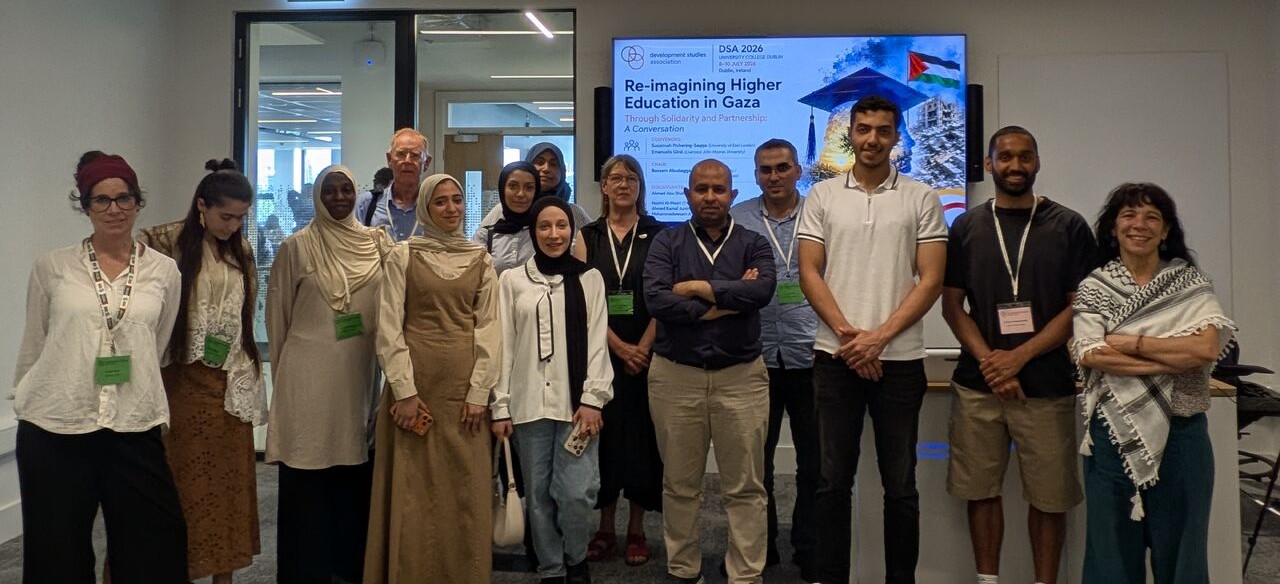
Bringing Gaza to the DSA conference
The NGO and Development Study group have been consistently convening panels, driving advocacy providing thought leadership on Gaza at DSA conferences. Emanuela Girei reported from the two-session workshop Re-imagining Higher Education in Gaza through Solidarity and Partnership that she convened with Susannah Pickering-Saqqa.
At the 2026 conference, Bassem Abudagga, chaired and opened the workshop, framing it within the ongoing genocide and scholasticide, the systematic destruction of Palestinian education. Besides the annihilation of infrastructure, Bassem emphasised that scholasticide continues through efforts to prevent rebuilding and to undermine existing institutions. As academics, Bassem argued, we share a collective ethical responsibility to support and protect HE in Gaza.
Nazmi Al-Masri reflected on a 30-year partnership with the University of Glasgow, built on local agency, shared leadership, mutual trust, and a shared ethical commitment toward the Palestinian right to education. He presented several impactful projects, such as Lines4Palestine. He also shared with us the emotional return to in-person teaching and what it means to teach during a genocide, with classes filled with grief and trauma, and hope, determination and resilience.
Ahmed Abushaban emphasised the importance of strengthening existing HE institutions through partnerships, including the Emergency Committee of Universities in Gaza. He emphasised that academic and intellectual leadership should remain in Palestine, while calling for international collaborations with the excellent scholars and students in Gaza, to nurture the existing academic community, build evidence for accountability and generate knowledge to rebuild the HE sector and beyond.
Mai Al-Jidi, a top graduate of the first cohort of the Veterinary Medicine program and a faculty instructor, shared her experience as a woman ECR and genocide survivor. Her testimony, and those of other ECRs and students, described days spent wandering outside in search of an Internet connection, studying when everyone was sleeping, in overcrowded spaces, while being displaced multiple times, losing relatives without saying goodbye, the hunger and the exhaustion. Yet Mai keeps going to the clinic every day, even without pay, and students keep going to classes, because, as they told us, education in Gaza is more than education; it is also hope, resistance and community.
Dr Mohammedwesam Amer presented some initiatives from Academic Action Network for Palestine, including Student-at-Home Scholarships, helping top students to complete their postgraduate degrees and The Academic Rifqa programme, providing individual companionship and guidance to Palestinian students and academics.
The workshop offered powerful insights into how staff and students continue to ensure institutional continuity, nurture and protect the vital role of HE in Gaza and what can be done to support them and protect the right to education.
Originally posted on Linkedin by Emanuela Girei
Kristen Hope presented preliminary thoughts from her research with displaced Palestinian adolescents. Starting with the provocation « So you want to conduct decolonial, feminist research with children during genocide? », she spoke about how decolonial and feminist theories help us to better understand, identify and dismantle Eurocentric, extractivist research with children. She explore how political reflexivity and multimodal ethnography might open up spaces for research as resistance.
Find out more and connect with Kristen.
Ethics of research on Gaza: Knowledge, power, and responsibility during and after genocide was convened by Basma El Doukhi (University of Kent) and Miram AbuDaqqa from Al-Aqsa University-Gaza.
Funding from the DSA enabled four full waivers and a half waiver for students from Gaza to take part in the conference.