
Opening doors to new research connections
Every year, the DSA works to secure funding so that researchers who might otherwise be unable to attend can take part in the annual conference, either in person or online. Demand consistently exceeds the funding available. This year, additional support from University College Dublin’s School of Politics and International Relations and Irish Aid enabled even more researchers to join colleagues in Dublin.
For many participants, that support meant more than attending a conference. It created opportunities to share research, build international collaborations and strengthen connections across the global development studies community.
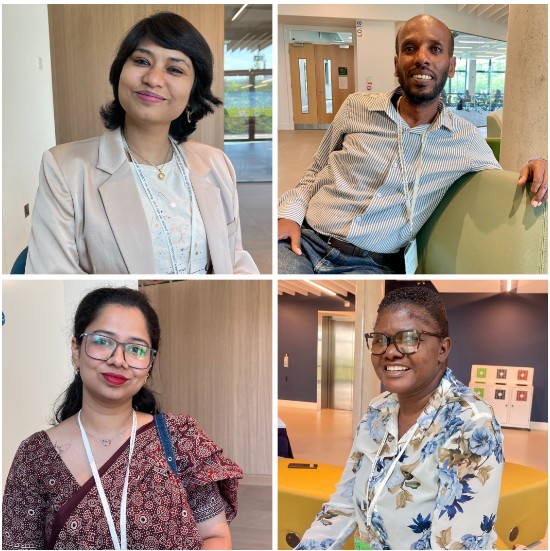
Nigatu Wolkanto, Wolaita Sodo University, Ethiopia
Supported by Irish Aid, Nigatu returned to Dublin three years after completing his PhD at University College Dublin. His research examines the political economy of the green transition, focusing on the social justice implications of large hydropower projects in Ethiopia’s Omo Basin.
Now teaching political economy and international relations at Wolaita Sodo University, he described returning to Dublin as both professionally and personally significant. “I’ve been working in a very constrained funding environment. I’ve been struggling to take part in academic events like this because the funding constraint is a barrier.”
“My affiliation with Wolaita Sodo University doesn’t provide any financial support for my travel here, so the support I got from Irish Aid is really tremendous. Without that support, I couldn’t even make my way to this platform.”
As a first-time DSA conference attendee, he valued the chance to reconnect with former colleagues while building new relationships. “For me, it’s an opportunity to network with colleagues who have similar research interests… I hope there will be an opportunity for further engagement with these people.”
Mavis Macheka, Great Zimbabwe University
Irish Aid also supported Mavis Macheka, whose research explores climate change, health-seeking behaviour and political economy in Lesotho. Her work shows how climate-related disasters force vulnerable communities to make impossible choices.
“During disasters we find that patients with chronic illnesses… have to choose between food and medicine…. Climate change is not mainly an ecological problem. It is now also a social and political problem, where climate change exposes these structural forces that disrupt the whole landscape of access.”
Mavis has been part of the DSA community since 2018. She first received DSA conference funding in 2019 and has applied for support each year since. This year, Irish Aid funding enabled her to attend DSA2026 in person. “If I hadn’t received the Irish Aid funding, I wasn’t going to come, I was going to attend online.” Being in Dublin, she said, made all the difference. “Being here makes a difference because of the networking. You engage with both Global South scholars and Global North scholars. You meet other people and maybe develop future research proposals together.”
Anjali Chauhan, University of Delhi
Funding from UCD’s School of Politics and International Relations enabled Anjali Chauhan to present her doctoral research on women’s labour chowks in Delhi NCR. Her ethnographic research examines how these waiting spaces become sites of knowledge-sharing, solidarity and resistance. Presenting in a panel focused on resisting economies was especially meaningful.
“It was the first time I had found a panel that explicitly focused on resistance… I feel that, for the women workers I’m working with, that’s the least I can do—to represent them in a panel that talks about resistance and power.”
She also reflected on what the funding meant personally. “The funding was really important because I come from a very conservative family, where women’s education is not supported. I’ve had a lot of struggles to reach this stage. Unless I had full financial support, I wouldn’t have been able to continue that fight with my father to allow me to come here.”
The conference also opened new opportunities for collaboration. “We’re already talking about collaborating in the near future, and I’m really looking forward to that.”
Dr Jannatul Ferdous, Comilla University, Bangladesh
Dr Jannatul Ferdous, Associate Professor of Public Administration at Comilla University, presented research on migration. For her, attending the DSA conference offered valuable international exposure and the chance to exchange ideas with researchers from around the world. She emphasised that funding challenges do not disappear after the early career stage.
“Many funding opportunities are available for early career researchers, but this is a big challenge for researchers at our stage. “In a country like Bangladesh… we don’t receive funding or financial support to attend international conferences… Because of that, our opportunities and even our dreams become limited.”
She credits Irish Aid support with making her participation possible.”The DSA platform has given us a huge opportunity, and this funding has been the key reason that I was able to attend this conference.”
One of the highlights of the conference was finally meeting a scholar whose work has shaped her own. “I also had the opportunity to meet Professor Naila Kabeer for the first time… It was a wonderful opportunity to finally meet her in person.”
If you would like to contribute to funding to support a scholar from the global South to attend the conference, please get in touch.