
Fieldnotes from the Uncertain
By: Chiara Scheven, University of East Anglia and University of Copenhagen and Tom Parkerson, University of East Anglia
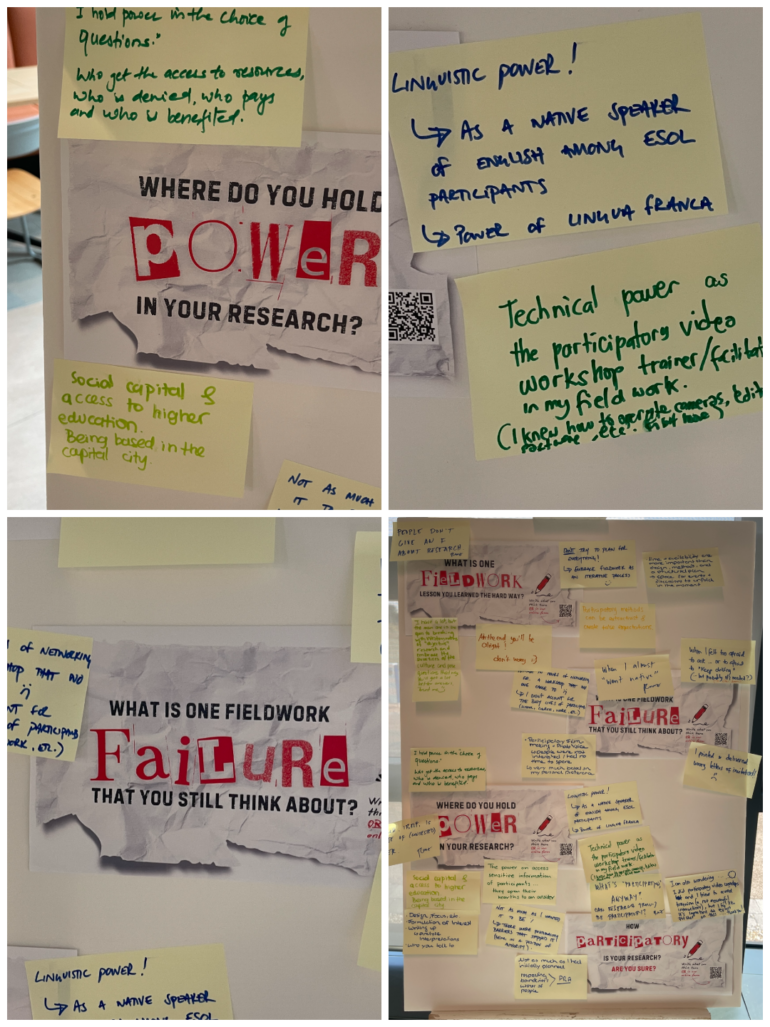
Some of you might have wondered about the board that appeared in different locations during registration and at the coffee and lunch breaks throughout DSA26 in Dublin. The story behind it goes back to when Tom Parkerson, Taibat Hussain, and I (Chiara Scheven) began to organise yet another panel to critique and reflect on participatory methods; we were certain we wanted to take it further than we had in Bath last year. Although the panel then received an overwhelming number of paper proposals, amounting to four sessions, to us, this was only the first step. The number of contributions demonstrated that many scholars, across all levels of experience, fields, and ages, were similarly concerned with the issues posed by participatory methods. As early-career researchers who had only just returned from our first long-term fieldwork engagement, we saw this as a place to reflect together on our experiences. Then, we envisioned the panel as a place to open untold, underrepresented, and fragmented fieldwork narratives that often remain hidden in brief, brushed-up paragraphs. Instead of simply confining our various encounters to a methodology chapter, we deliberately opened the subject to lay out sites of vulnerability, crisis, and uncertainty. Even though our specific experiences with challenges, struggles, frustrations on the one side, and rewarding, connecting, and surprising moments on the other remained individual, we kept on coming back to the same set of questions.
Those questions arose as a red thread tying the contributions in Bath together, regardless of the researchers’ positionality, research context, or field of study. We all grappled with the question of power. While most of us read and prepared a lot on decolonial methodologies and participatory methods, eager to engage people on eye level, we all came to the same query: Is the term participatory in the end merely a fuzzword for an ideal scenario that most of us will chase throughout our entire career? Can we truly offset power inequalities through and within our research? And if not, what else is there to be done? Will research always be extractive to a degree?
This year, we took these, we must admit, gloomy questions as a point of departure. However, after one year, to take our reflections further, we concluded that rather than writing off participatory attempts outright, we would continue to advocate for their ethical utilisation. Instead of assigning glamorous research terminology and promises, we wanted to hear the everyday stories. Rather than attempting to make fieldwork sound like a walk in the park, we found that vulnerabilities and struggles were where our learning and unlearning began. In this, we simultaneously reject the all-too-often perpetuated idea of fieldwork as a young researcher’s coming-of-age story in which we prove ourselves to an academic community. Through our experiences, we recognised the value of transparency, of real encounters, connections, collaborations, uncertainties, and continued reflectivity. None of which deserves to be undermined as obstacles within the process of knowledge production. Researchers, as much as the people we research with, are worthy of being treated as individuals rather than data points or collectors.
All this being said, in this year’s panel, we sought to disclose our uncertainties in everyday fieldwork encounters. We wanted to carve out those stories that remain unfinished and therefore often untold. In keeping with our initial critique and reflections on participatory methods, it was only logical to apply one of those approaches ourselves to reach a wider audience and engage more researchers. This is how we came up with the idea to install an easel with a set of questions leading into the discussion taking place as part of our panel on Thursday afternoon. Our main aim was to prompt DSA attendees to reflect on questions about power, fieldwork, failures, and participatory methods. This then led to broader inquiries, such as how scholars navigate tensions arising from power imbalances. What can we learn from our vulnerabilities and uncertainties? What happens when collaboration doesn’t go to plan? When does participation redistribute power, and when does it reinforce tokenism?
We are grateful for the strong turnout, which laid the foundation for our panel discussion. Simultaneously, the response to our Researcher Reflection Board was positive among conference attendees, not only those joining our panel. Alongside bridging the gap between the informal discussions that emerged from the conference lobby and our panel, many were grateful for an engagement activity in between sessions. We would like to stress the need for more interactive engagement activities in general and in our case, as the discussion underscored our need for open spaces to discuss our own experiences and challenges. One of the attendees summed it up by calling the panel a safe space that allows us to be vulnerable about our own uncertainties, which accompany us at every step when conducting, designing, and writing about research. In this, our experience here connects well with contemporary and established readings of participatory methods. Instead of using “participatory” as a label to check the boxes for decoloniality and the redistribution of power, we tune in to feminist and decolonial voices advocating for transparency and vulnerability (Smith, 1999; Nhemachena, Mlambo and Kaundjua, 2016; Kanyamuna and Zulu, 2021; Boer Cueva et al., 2024; Omodan, 2025). The focus should therefore be: Where can we maintain an ethical and decolonial approach while acknowledging the shortcomings in our methodologies and research design?