
After the headlines fade: Filming life between one rain and the next
By Dr Neha Yadav
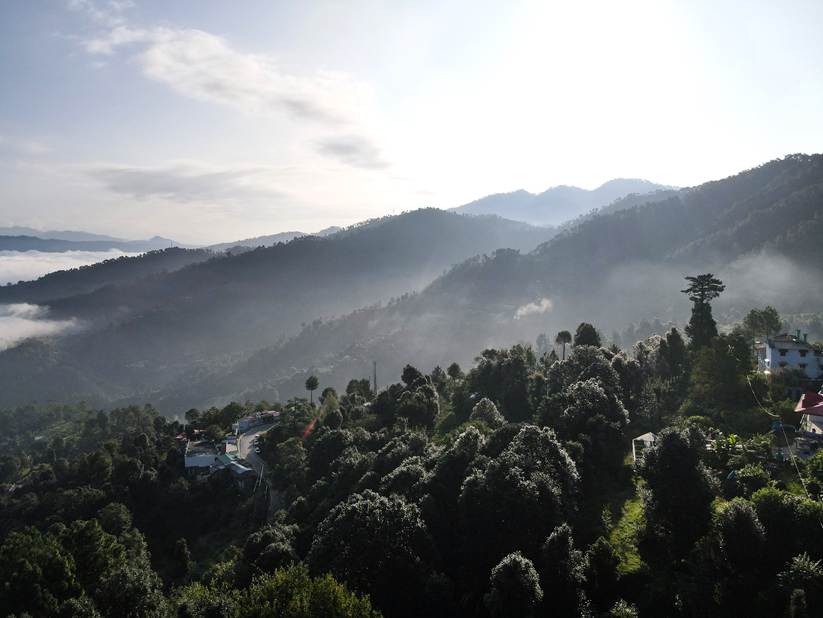
Mountain settlements and forested slopes in Himachal Pradesh. Credit: Between One Rain and the Next production team.
Neha Yadav reflects on documentary filmmaking as a qualitative method for understanding how recurrent disasters, landscape instability and development pressures reshape mental health and well-being, livelihoods and everyday life in mountain communities.
When a flood becomes news, attention gathers around the visible event: the river changing course, the road collapsing, the hillside giving way. For those who live there, disaster does not end when the rain stops. It remains in cracked walls, inaccessible livelihoods, sleepless nights and decisions deferred until the next monsoon.
Between One Rain and the Next is a 23-minute research-led documentary filmed with four communities in Mandi and Kullu districts of Himachal Pradesh. Its central question is: What happens to people’s mental health and well-being, homes and sense of the future when uncertainty becomes part of everyday life?
Two monsoons and an unfinished recovery
The film is set against two severe monsoon periods, in 2023 and 2025. Floods, landslides and ground instability damaged homes, roads and livelihood spaces across Himachal Pradesh. For some of the people I met, the second period of disruption arrived before recovery from the first was complete.
Rather than reconstructing one dramatic event, the documentary stays with the slower aftermath. In Parashar and Baggi, a changing river made livelihood spaces inaccessible. In Malta, cracks and subsidence crossed the threshold of the home. In Bandal, people continued to live with instability even where risks had been studied. Across these locations, uncertainty entered ordinary life: cooking, caring, working, sleeping, remembering and trying to plan ahead.
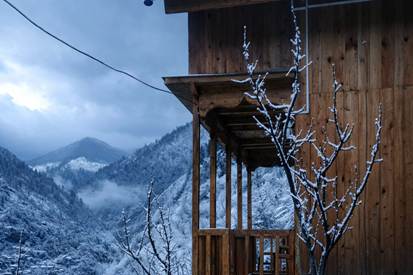
A home in Bandal village during winter. Photograph shared by a resident of Bandal village.
When uncertainty enters the mind and the home
Repeated disruption affects more than physical safety. Participants spoke about sleeplessness, anxiety when rain returned, hopelessness when livelihoods became inaccessible and the strain of living in a house that might no longer remain safe. These accounts revealed socially and environmentally produced forms of distress, shaped by repeated loss, prolonged uncertainty and limited control over what might happen next.
The home is central to this experience. A place associated with shelter can become a source of fear when cracks deepen during rainfall or a tent feels safer than sleeping indoors. Livelihood loss also narrows the future. A business may still be standing, but when customers can no longer reach it, the investment, independence and plans attached to it are suspended. Mental well-being is therefore inseparable from housing, income, care, place and the ability to make meaningful decisions about remaining, rebuilding or relocating.
These experiences accumulate rather than replace one another. One participant’s restaurant still stands beside the river, but customers can no longer reach it. Another family sleeps in a tent when rain deepens the cracks in their home. An older resident, having rebuilt after a fire and the loss of his shop in the 2023 floods, faced instability beneath his house in 2025. Their accounts show why recovery cannot be understood as a return to a stable “before”.
The film also attends to the practices through which people continue. Household care, relationships with neighbours, memories of earlier disasters and faith in local deities can help people live with uncertainty. Yet these sources of meaning should not be used to romanticise endurance or to excuse the absence of sustained institutional support.
Development and unequal vulnerability
The documentary resists treating disaster as the consequence of a natural hazard alone. Environmental and scientific contributors consider how intense rainfall and fragile mountain terrain interact with road widening, slope cutting, hydropower construction, tunnelling, heavy machinery and changing land use. The film does not assign every landslide or episode of subsidence to a single cause. Instead, it makes visible the contested relationship between development, environmental change and responsibility.
It also exposes the gap between identifying a risk and reducing it. Slopes may be studied and protective measures proposed, while families continue to live with danger because implementation, resources or institutional coordination do not follow. Knowledge of risk, in other words, does not automatically become protection.
Exposure to a shared hazard does not produce a shared experience of disaster. Some households can relocate, rebuild or absorb a temporary loss. Others remain on unstable ground because they have few alternatives. Vulnerability is therefore shaped by livelihood dependence, access to safe land and financial resources, the implementation of risk-reduction measures and the willingness of institutions to respond. This raises a difficult development question: who benefits from decisions made in the name of progress, and who is left to live with their risks?
A research question that exceeded the fieldnotes
I began this work as a qualitative researcher, not as a filmmaker. The project grew from year-long fieldwork conducted between October 2024 and October 2025. It involved repeated visits, 12 in-depth interviews, six of which became filmed testimonies, nine oral histories with a separate group of participants, informal conversations and observational filming. Community accounts were placed in dialogue with scientific and environmental perspectives on rainfall, river behaviour, slope instability, land-use change and development pressures.
The film did not replace qualitative research; it grew from it. Repeated visits made it possible to listen across seasons and to understand how an account changes when rain returns, a crack deepens or an expected intervention does not arrive. The camera added another layer. It held the relationship between testimony and place: the distance between a restaurant and the road that once brought customers, a tent beside a home that no longer felt safe, or a pause before someone described beginning again.
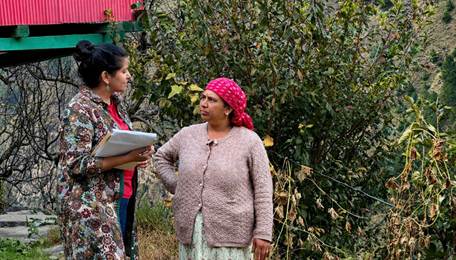
Neha Yadav in conversation during fieldwork in Himachal Pradesh. Credit: Between One Rain and the Next production team.
What the camera made possible and difficult
Documentary filmmaking can make research more public, but visibility is not neutral. Editing creates narrative power. A person’s words may travel far beyond the conversation in which they were first spoken, and images of distress can too easily become spectacle. The challenge was therefore not only to make less visible harms visible, but to do so without asking people to perform suffering for the camera.
Documented consent was obtained for research participation and filmed representation. Ethical practice also shaped the edit: testimony was not used to make scientific claims it could not support; pauses and emotion were treated with restraint; and the film avoided presenting resilience as a simple or celebratory ending. People do care, adapt and rebuild, but this work has material and emotional costs, and those costs are unevenly distributed.
Film also made absence legible. Conventional accounts of disaster tend to count damaged structures, roads and crops. Those measures matter, but they do not easily register anticipatory fear, sleeplessness, the care required to sustain a household, or the difficulty of imagining a future in a place that no longer feels predictable. Documentary offered a way to place those quieter experiences within the material landscape that produced them.
From engagement to responsibility
At the DSA Scotland annual meeting in Glasgow, a short segment of the documentary opened the panel on Research, Engagement and Action. Beginning with the film meant that the communities’ voices and landscapes entered the room before my analytical interpretation. It created a basis for discussing documentary not simply as dissemination, but as a research method that can connect lived experience, scientific knowledge and public debate.
That connection is only the beginning. Wider reach does not itself constitute change, and a screening does not resolve the conditions shown on screen. Public engagement becomes meaningful when it creates sustained attention, opens routes to dialogue and keeps questions of institutional responsibility in view.
Between One Rain and the Next does not offer resilience as an easy answer. Its more difficult question is how often communities should be expected to absorb loss, care for others and begin again, while the conditions producing their vulnerability remain insufficiently addressed. Once affected communities have spoken, and once we have witnessed their experiences, who carries the responsibility to respond?
Watch the 90-second teaser: Between One Rain and the Next
Short author biography
Dr Neha Yadav is a Senior Research Fellow at the Centre for Corporate Responsibility and Sustainability in Zurich. Her research examines climate change, mental well-being and everyday life, with a focus on qualitative, visual and publicly engaged methods. She is the researcher and director of Between One Rain and the Next. Film updates: @After_Deluge.
Film and research details
- Running time: 23 minutes
- Languages: Hindi and Kulluvi, with English subtitles
- Locations: Parashar and Baggi in Mandi district; Malta and Bandal in Kullu district
- Fieldwork: October 2024 to October 2025
- Research and direction: Dr Neha Yadav
- Cinematography: Md. Meharban
- Research collaboration: Ashutosh Singh
- Editing: Kashif Shakeel
- Funding acknowledgement: Developed through a K2A-supported project at the Centre for Corporate Responsibility and Sustainability, Zurich