
Beyond access: how crisis shapes girls’ educational trajectories
By DSA member Najwa Sabek, MUBS – Lebanon
For eighteen years, from 1982 to 2000, many families living in the occupied border area of South Lebanon were reluctant to send their daughters to university. The nearest universities were in Beirut, far from their villages, and travelling there was often difficult and dangerous because of the Israeli occupation and insecurity. In my experience, relatively few girls from these communities were able to pursue higher education during that period. Following the Israeli withdrawal in 2000, opportunities for girls to access university education expanded.
I experienced these challenges firsthand. Travelling to university usually took around two hours, but on days marked by checkpoints, inspections and insecurity, the journey could exceed six hours. Continuing my education required more than academic commitment; it demanded time, money, resilience and the ability to navigate uncertainty.
These experiences shaped how I understand girls’ education in crisis settings. Access is only the beginning of an educational journey; it does not guarantee regular attendance, completion or progression. Educational exclusion must therefore be understood through the barriers that accumulate along the way.
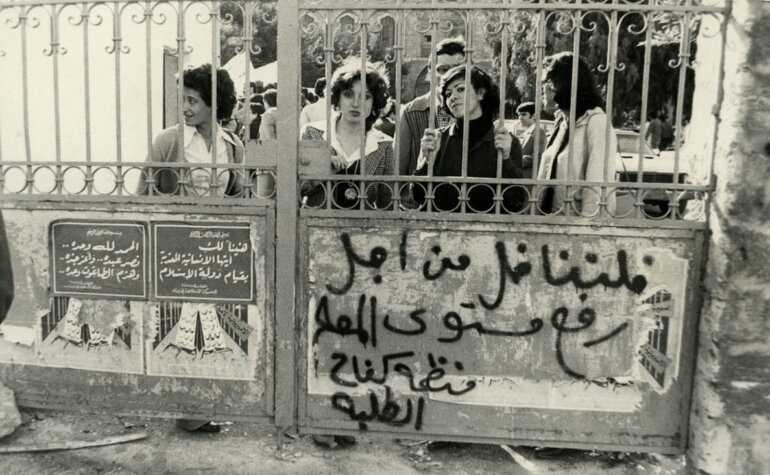
Above: An undated photograph of a demonstration in front of the Faculty of Law in Sanayeh, Lebanon from The Public Source.
Deliberately closed pathways
Afghanistan illustrates the most explicit form of exclusion. In August 2026, UNICEF reported that more than 2.6 million girls had been denied secondary education since 2021. Girls remain barred from formal education beyond Grade 6, while women are excluded from universities. This is not simply a problem of damaged schools or household poverty: it is an institutional restriction that closes an entire educational pathway.
In other crisis settings, exclusion may be less formal but no less consequential. In Sudan, more than eight million school-aged children remained out of school after three years of conflict, displacement and widespread disruption. In South Sudan, more than 2.8 million children are out of school, with girls among the most affected; poverty, child marriage and social norms are significant barriers. When families lose income, move repeatedly or face unsafe journeys, girls’ education can become one of the first needs sacrificed—and one of the hardest to restore.
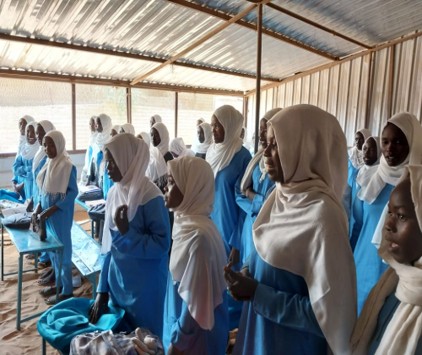
Above: Girls and young women participating in an educational or skills-building activity.
The Strategic Initiative for Women in the Horn of Africa (SIHA) works across Sudan and
South Sudan to promote girls’ access to education, women’s empowerment and gender equality.
Schools that exist but are out of reach
In Yemen, girls’ education is affected not only by conflict and poverty but also by child marriage and early pregnancy. UNICEF reports that approximately 30 per cent of young women aged 20–24 were married before the age of 18. Early marriage and motherhood can interrupt education and restrict girls’ future opportunities. Keeping girls in school therefore requires more than access to classrooms: it also means protection, reproductive health information, support for adolescent mothers and flexible opportunities to return to learning.
Barriers changed by displacement
For Syrian girls, displacement reshapes educational barriers. UNICEF estimates that 2.45 million children in Syria are out of school, while over one million are at risk of dropping out. In Lebanon, around 610,000 registered Syrian refugee children and young people aged 3–24 face significant educational challenges. According to UNHCR’s 2025 education figures, only 50 per cent of children aged 6–14 are enrolled at primary level, while secondary enrolment stands at 15 per cent and higher education participation at 10 per cent.
Economic hardship, insecurity, transport costs and gender expectations make continued education difficult. For some girls, financial pressures and family responsibilities lead them to leave school and work to support their families. Early marriage can also contribute to dropout, alongside poverty and limited access to education, UNFPA reports show.
Context specific responses
Across these contexts, barriers take different forms: institutional exclusion in Afghanistan; conflict and displacement in Sudan and South Sudan; child marriage and early pregnancy in Yemen; and intersecting economic and gender pressures in Syria and Lebanon. Yet the pattern is similar. Girls’ education is not disrupted only when schools close. It can also be interrupted gradually when journeys become unaffordable, attendance becomes unsafe or families can no longer support their daughters’ education.
The same outcome, leaving school, can result from very different causes. Each requires a context-specific response. Three priorities are particularly important:
- Measure educational continuity, not just access. Governments and organisations should monitor attendance, retention, transition and completion, with data disaggregated by age, gender, displacement and disability.
- Address the practical barriers that keep girls out of school. This includes affordable transport, safe school facilities, learning materials, financial assistance, psychosocial support and flexible opportunities to return to education.
- Include girls and their families in decision-making. Their experiences and perspectives should inform the design and implementation of education policies and programmes.
My experience in South Lebanon taught me that determination matters, but it cannot overcome every obstacle. The responsibility should not rest on girls’ resilience alone. The real measure of educational access is whether every girl has a fair and sustained opportunity to continue learning, complete her education and shape her own future.
By DSA member Najwa Sabek, MUBS – Lebanon
This article gives the views of the author/academic featured and does not necessarily represent the views of the Development Studies Association as a whole.