Tips for writing journal articles: insights from a PhD-led workshop
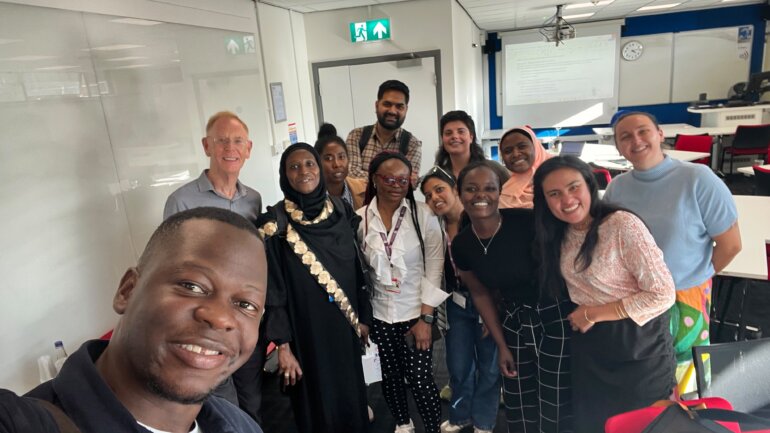
Our DSA student members are entitled to apply for funding to run activities. Two members Chidinma Mbaegbu and Saloni Pradhan, both PhD candidates at the University of Leicester, successfully put together a proposal to run an in-person writing workshop. Both the DSA and the PhDs were delighted with the outcomes.
“For me, the writing workshop became a reality once I saw the congratulations notification email from DSA Admin on being awarded the PhD/ECR Award,” said Chidinma Mbaegbu. “I could not believe that the writing workshop dream written as a proposal was finally becoming a reality.”
The workshop was led by Professor Gordon Crawford, Emeritus Professor in Global Development, Centre for Peace and Security, Coventry University with support from Dr. Zainab Mai-Bornu, Associate Professor of International Relations, University of Leicester.
- Find out more about student grants if you’re a student member
- Get a list of takeaways from the workshop – you can also add your own insights to the bottom of this document.
- Read on to find the Chidinma Mbaegbu and Saloni Pradha’s perspectives on the workshop
What are journals looking for from authors?
By Chidinma Mbaegbu
Originality, significance and rigour were three aspects highlighted by Professor Crawford that journals are looking for. These are the same three points REF panels use to assess research outputs. Prof Crawford frames these points as useful questions for aspiring authors:
- What is actually new in what I am researching or writing and why does it matter to the field? To be original does not mean something that has never been done, rather it could be an extension in argument, concept, new empirical material, innovative methodology or analysis of policy and practice.
- What is the significance of the study – the importance, value or impact of the result?
- And finally, have I been precise enough in how I have presented my argument?
Selecting the right journal
I have always assumed that once I write an article, I will find the right journal for it. However, this session gave me a more informed perspective; to research the journal first before setting out to write the article. Choosing early, thinking about fit, about whether a regional journal suits the work better than a generalist one, the word limits and open access policy would change how I need to write in the first place.
Writing your introduction, literature review and abstract
I received feedback from Prof Crawford on my abstract, and methods sections of my article. I am happy to have achieved this at the workshop and will complete the various sections drafts I had done.
Have I developed a clear argument to have a logical flow? How have I positioned the research within existing literature? How have I structured the introduction and literature review? How can I write an effective abstract?
Some people highlighted that they prefer to write an abstract first before developing the article to help map out and guide the writing process.
Developing your methodology
Prof Crawford kept pushing the room to consider: does your methodology actually match your research questions, or have you just described what you did? This section forced me to review how I have always thought about the methodology section in my research.
It is one thing to know your epistemological position in theory but this really forced us to think about presenting our methods clearly and convincingly, and ensuring alignment between research questions, methods and analysis.
Writing your findings, discussion and conclusion
Prof Crawford talked about using direct quotes from participants and referencing them properly, to give the reader a sense of who is speaking and why it matters, while still protecting anonymity. This is an important point about respect: making sure the people whose words carry your findings remain visible as people, not just data.
This helped to clarify on the issue of maintaining participants anonymity while still making visible their perspectives and lived experiences. I hadn’t thought about methodology as an ethical practice in quite that way before.
By Chidinma Mbaegbu
Participant reflections on a PhD writing workshop
By Saloni Pradhan
I wanted to capture what the day meant for the people who took part and what other training they might like next. The feedback gathered was anonymous and the names of the participants have not been included.
Making journal writing manageable
The most common theme was the sense of an intimidating process becoming manageable. One participant admitted that, despite earlier seminars on journal writing, they did not know the basics of how to draft and submit a journal article before attending. For a PhD student moving from field-based development practice into academia, the structured breakdown “demystified what often feels like an intimidating process,” and concrete guidance on word counts for each section offered a clear framework for turning raw field research into a submission-ready article.
Professor Crawford was honest about the realities of publishing. A student beginning the thesis-writing stage found it encouraging to hear an experienced facilitator say that journals sometimes reject their work, and that review timelines do not always go to plan. The takeaway was to be “eager to put my ideas and work out there for others to read” rather than discouraged. This resonated for quite a few others struggling with journal response times and the editorial process.
The session was structured so participants also had time to write. Participants echoed the importance of this. One valued being given time to work on their own articles, with the facilitator coming around to give us personal feedback. Another said the practical space was “crucial for digesting the new knowledge and mapping out next steps”.
Bringing PhD candidates together physically in the room was important for building community. One attendee found the day “valuable and energising”, enjoyed building relationships and comparing writing experiences, and was reminded that “writing doesn’t have to be a solitary pursuit”. They hope the community will outlast the day.
How can PhD writing continue to be supported?
The biggest suggestion for improvement was time. Several people asked for more of it, ideally a “two day training residency retreat,” a multi-day workshop with more time for writing and reviewing, or a retreat-style event where attendees could review each other’s drafts or even publish together.
Others offered practical design ideas. One suggested asking participants to start their article beforehand, working in groups on specific sections, and swapping papers at the end for peer feedback. Another proposed a short drop-in session or online peer-review group a few weeks afterwards, so people can check progress on the changes they planned.
There were also content requests. One participant wanted to hear how scholars disseminate their work to wider audiences, through conferences or blog posts for example, and whether those strategies affect citation. That is a natural topic for a future session.
The message is encouraging, in that, people found the workshop useful, and they want more of it. There seems to be a consensus within the PGR and ECR community that such workshops are needed not just for the training they provide, but for the community they create. We, as the organisers, did not have the bandwidth to do follow-up sessions or informally organise a group. But we do hope to pick this up again at a later date and/or encourage others to do so as well. We have in mind that these sessions can also be conducted as online writing groups, which would be accessible and do away with travel. Longer formats, built-in peer review and follow-up would turn a good day into a lasting community of writers.
Thanks to Professor Gordon Crawford and Dr. Zainab Mai-Bornu for their time and advice, for the participants that attended the workshop and most especially to the DSA for funding it.
By Saloni Pradhan
- How can DSA members organise their own event like this? – find out more about student grants
- Get a list of takeaways from the workshop or add your own insights to the bottom of this living document.